Wednesday, January 6, 2016

SANTO NIÑO DE TERNATE AND ITS FESTIVITIES/TRADITIONS

SANTO NIÑO DE TERNATE AND ITS FESTIVITIES/TRADITIONS


By: Dindo Mojica, C.E., M.Eng


Updated: January 31, 2016


PROGRAM/INVITATION:


Baña de Santo Niño de Ternate
(The Bathing of the Holy Child Jesus of Ternate)
(Ang Pagpapaligo sa Mahal na Poong Santo Niño de Ternate)


December 31, 2015


The Baña de Santo Niño de Ternate (The Bathing of the Holy Child Jesus of Ternate) is a tradition which dates back to 1663. This annual tradition (Ang Pagpapaligo sa Mahal na Poong Santo Niño de Ternate) is being held every 31st day of the month of December. The Santo Niño de Ternate is taking a bath and changes his dress for the upcoming town fiesta (of the Municipality of Ternate, Cavite) on January 5-6. The image will again change his vestments on January 5, after the caracol and holy mass in his honor.

One of its old traditions is that giving the Santo Niño a bath annually before the New Year’s Eve. It was believed that the water that was used to bath the Santo Nino can cure many illnesses, where the perfumed water used to bathe the Santo Niño is placed in bottles and distributed to the faithful/devotees.


With Father Nestor P. Chavez and Ternate Municipal Councilor Khalil Lorenz Soberano 
conducting the Baña de Santo Niño de Ternate


The water that was used to bath the Santo Nino
(gave to Parishoners after the Ceremony)

Youtube:

Bathing of Santo Nino de Ternate December 31, 2015 (Part1)


Bathing of Santo Nino de Ternate December 31, 2015 (Part2)


Photos:

Catholic


Aglipayan


Atavio de Santo Niño de Ternate
(The Ritual Robing of the Holy Child Jesus of Ternate)
(Ang Pagbibihis sa Mahal na Poong Santo Niño de Ternate)

Atavio is a Spanish term which means robing or pagbibihis, to dress up or put on the vestments. The rite of the dressing of the statue of Santo Niño de Ternate is an old tradition that conducts every New Year’s Eve or December 31 after the Baña de Santo Niño de Ternate ceremonies (The Ritual Bathing of the Holy Child Jesus of Ternate) and changes his dress for the upcoming town fiesta (of the Municipality of Ternate, Cavite) on January 5-6.


The Santo Niño de Ternate changes its dress every last Sunday of the month for Catholics and for Aglipayans, more than a month or depending on the schedule and the availability of the person who will sponsor the robing of the Santo Niño de Ternate.

The Ritual Robing of the Holy Child Jesus of Ternate

The Ritual Robing of the Holy Child Jesus of Ternate


 AFTER CEREMONIES

 Picture-taking after the ceremonies 
with my friend and a Niño brother, Mr. Jeffrey Rollon


Flickr (more photos at:)


Kapatiran sa Santo Niño de Ternate
(Brotherhood/Sisterhood to the Holy Child Jesus)

Usually, you must register to the Kapatiran ng Mahal na Poong Santo Niño de Ternate annually (during fiestas/feast days). You may place an amount of money (donation) to the Santo Niño de Ternate and you may state your intentions to the Holy Child Jesus. It includes the receipt/petitions to the Santo Niño, a card with a picture of Santo Niño (at the back is the song for the Santo Niño) and the bottled perfumed water of the Santo Niño’s bathe (if it’s still available due to many devotees/while supply lasts)

Front Card


Back Card

Donation Receipt


Caracol/Karakol/Religious Procession Dance


January 5

The Beginning of the Celebration of the Feast of the Santo Nino de Ternate.


The original image of the Santo Nino de Ternate was brought outside of the church on 1 pm and will return to the church on 5 to 6 pm for the Karakol. After the Karakol, the last Day of the Novena of the Santo Nino de Ternate will be conducted. It will be followed by the Holy Mass and after the Holy Mass, Santo Nino de Ternate will change its vestments.


The Caracol Festival in honor of the Santo Niño de Ternate

Karakol is a religious procession dance performed during fiestas. It features a fluvial procession performed by folk music played by a brass band or a recorded music (mobile sound system) and street dancing by children, teenagers, and women in fancy dress and hat. . As the image of the Holy Child was brought out of the church, the karakol will start with a parade of performers (usually devotees, and locals) going to the town proper while dancing to effervescent music to show their sincere devotion to the Holy Child and will end at Maragondon River (in Barangay San Jose) for the fluvial procession.

The image of the Santo Niño de Ternate is said to have been brought by Jesuit missionaries from the Group of Moluccas Islands in Indonesia (also known as Spice Islands in History books) to Cavite where Malay settlers, including the Sepoys from India, were given settlements and enjoined to keep a lookout on seafaring marauders.

The Holy Child Jesus of Ternate Caracol conducts every January 5, the eve of the Patron’s feast for the Catholics and for the Aglipayans, they conduct the Caracol on every Feast Day of The Holy Child Jesus of Ternate (January 6)

More information about the culture of Karakol:


Actual Karakol (Catholic)


January 5, 2016 Karakol

Karakol is a religious procession dance performed during fiestas. It features a fluvial procession performed by folk music played by a brass band or a recorded music (mobile sound system) and street dancing by children, teenagers, and women in fancy dress and hat. . As the image of the Holy Child was brought out of the church, the karakol will start with a parade of performers (usually devotees, and locals) going to the town proper while dancing to effervescent music to show their sincere devotion to the Holy Child and will end at Maragondon River (in Barangay San Jose) for the fluvial procession.


Karakol last January 5, 2014

The fluvial parade after conducting Karakol
 (crossing Maragondon River at Barangay San Jose)


Actual Karakol (Aglipayan)


Karakol and Fluvial Parade


FEAST DAY OF THE HOLY CHILD JESUS OF TERNATE
(Ang Kapistahan ng Mahal na Poong Santo Niño de Ternate)


The feast of Santo Niño de Ternate is celebrated annually on January 6. Since the Santo Niño de Ternate is widely known for the many miracles attributed to it, religious devotees from all over Cavite as well as from neighboring provinces (Batangas, Bataan and Rizal Provinces specifically) flock every year to Ternate to attend the patron saint’s feast day.


Holy Mass will be celebrated as early as 4 am followed by Holy Mass at 5 am, 6 am, 7am and 8 am (depending on the schedule). The Con-celebrated Mass will be conducted at 9:30 am and led by the Holy Bishop of the Diocese of Imus with the clergy of the Diocese. At 6 pm, Holy Mass will be celebrated. After the Holy Mass, the Procession of the image of the Blessed Virgin Mary and the Santo Nino de Ternate will be conducted. On the start of the procession, fireworks display is usually held and usually provided by the Parishioners and Devotees of the Santo Nino de Ternate.


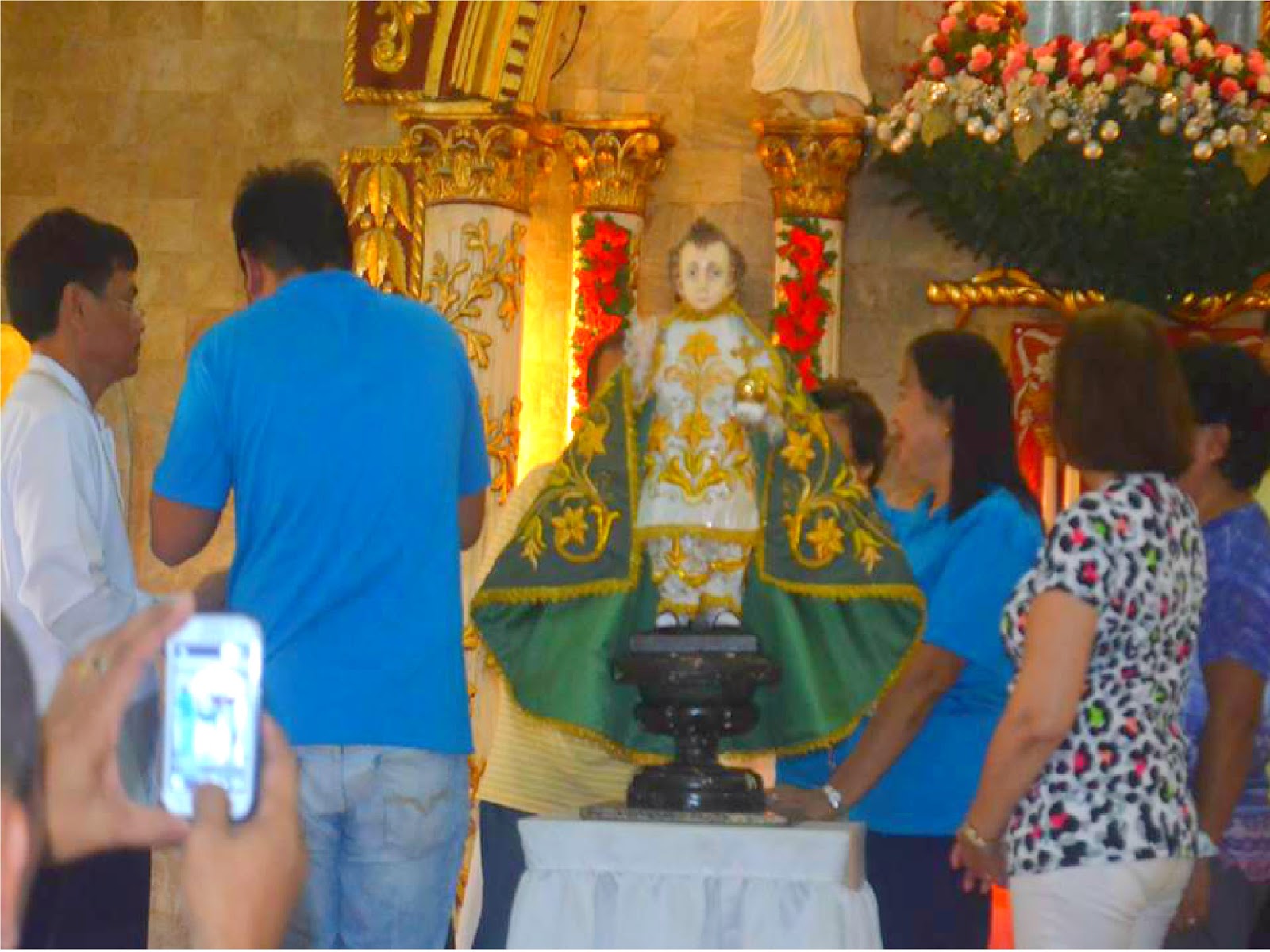
The image of the Santo Niño de Ternate had changed his vestments on January 5, 
after the caracol and holy mass in his honor


 Santo Niño de Ternate (Catholic)


Santo Niño de Ternate (Aglipayan)
PROGRAM/INVITATION:


THE REPLICA


PROCESSION:


HERMANIDAD DE SANTO NIÑO DE TERNATE
(Confraternity of the Holy Child Jesus of Ternate)


January 24, 2016

3rd Sunday of January


Celebrating the feast of Santo Nino by a Mass in his honor. Every year, a child (boy) acts as the Hermano Mayor. A Mass for the families of the Hermano Mayor was held in the morning and in the dusk before the procession. The Hermano Mayor is usually dressed in formal wear to the Mass in the morning and dress like the image of the Santo Nino clothing image of the Mass and procession at dusk. After the procession, the transfer of Bara Alta was held to the next Hermano Mayor led by the parish priest.

Hermanidad is a Spanish word which means Brotherhood. The feast of the Holy Child Jesus as celebrated by the people of Ternate, Cavite and devotees was led by a Hermano, an individual chosen to lead the festivities. For the said event, the Hermano would be a Boy. It will start with a Holy Mass and then followed by a Procession of the Santo Niños and the patron saint Santo Niño de Ternate. Hermanidad is a regular practice among many church organizations and the Hermanidad dedicated to the Santo Niño conducts annually on every third Sunday of January (The feast of the Santo Niño/Holy Child) for Catholics and for the Aglipayans, a week after.

Catholic:


THE PROCESSION: 


Hermanidad de Santo Nino de Ternate (Catholic) 2016


Aglipayan:


Hermanidad de Santo Nino de Ternate (Aglipayan) 2016


 AWIT SA SENOR SANTO NINO DE TERNATE
(A Song for the Holy Child Jesus of Ternate)

ni/by: JOHN ASHLEY N. MORALES

Monday, September 28, 2015

HISTORY OF MOUNT MAINAM LODGE NO. 49, F&AM, GLP

HISTORY OF MOUNT MAINAM LODGE NO. 49, F&AM, GLP


HISTORY OF MOUNT MAINAM LODGE NO. 49, F&AM, GLP

mt mainam logo copy3
Logo of Mount Mainam Lodge No. 49, F&AM, GLP


SAM_0381

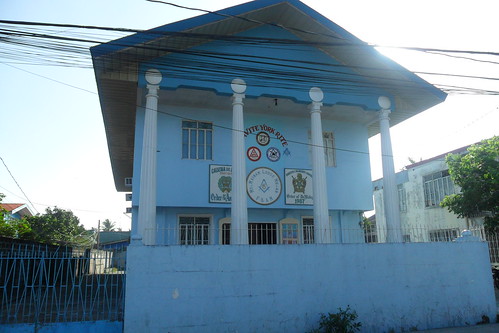
The present temple in Barangay Ibayo Estacion, Naic, Cavite


180715_1418028709654_1800746985_793388_3261811_n
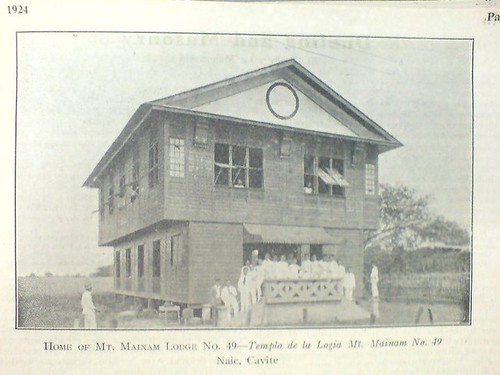
The old Masonic temple


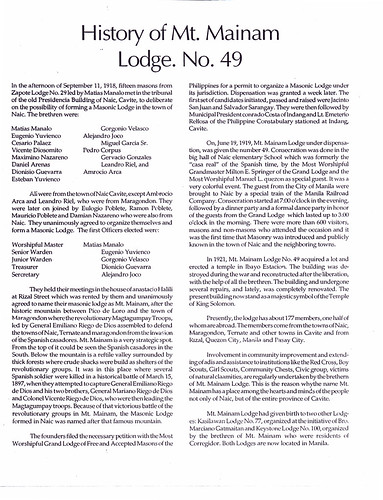
In the afternoon of September 11, 1918, fifteen brother masons from Zapote Lodge No. 29 led by Matias Manalo met in the tribunal of the old Presidencia Building of Naic, Cavite to deliberate on the possibility of forming a Masonic Lodge in the town of Naic. The brethren were:


Matias Manalo, Eugenio Yuvienco, Cesario Pelaez, Vicente Diosomito, Maximino Nazareno, Daniel Arenas, Dionisio Guevara, Esteban Yuvienco, Gorgonio Velasco, Alejandro Joco, Miguel Garcia Sr., Pedro Corpus Gervacio Gonzales, Leandro Riel, and Ambrocio Arca.


All were from the town of Naic, Cavite, except Ambrocio Arca and Leandro Riel, who were from Maragondon. They were later joined by Eulogio Poblete, Ramon Poblete, Mauricio Poblete and Damian Nazareno who were also from Naic. They unanimously agreed to organize themselves and form a Masonic Lodge. The first officers elected were:


Worshipful Master: Matias Manalo

Senior Warden: Eugenio Yuvienco
Junior Warden: Gorgonio Velasco
Treasurer: Dionicio Guevarra
Secretary: Alejandro Joco

They held their meetings in the house of Anastacio Halili at Rizal Street which was rented by them and unanimously agreed to name their Masonic lodge as Mount Mainam, after the historic mountain between Pico de Loro and the town of Maragondon where the revolutionary Magtagumpay Troops, led by General Emiliano Riego de Dios assembled to defend the towns of Naic, Ternate and Maragondon from the invasion of the Spanish Casadores. Mt. Mainam is a very strategic spot. From the top you could see the Spanish casadores in the south. Below the mountain is a reftile valley surrounded by thick forest where crude shacks were built as shelters of the revolutionary groups. It was in this place where several Spanish soldiers were killed in a historic battle on March 15, 1897, when they attempted to capture General Emiliano Riego de Dios and his two brothers, General Mariano Riego de Dios and Colonel Vicente Riego de Dios, who were then leading the Magtagumpay troops. Due to this historic significance of Mt. Mainam, the Masonic lodge formed in Naic was named after it.

The founders filed the necessary petition with the Most Worshipful Grand Lodge of Free and Accepted Masons of the Philippines for a permit to organize a Masonic Lodge under its jurisdiction. Dispensation was granted a week later. The first set of candidates initiated, passed and raised were Jacinto San Juan and Salvador Sarangay. They were then followed by Municipal President Conrado Costa of Indang and Lt. Emeterio Rellosa of the Philippine Constabulary stationed at Indang, Cavite.

On June 19, 1919, Mt. Mainam Lodge under dispensation, was given the number 49. Consecration was done in the big hall of Naic Elementary School which was formerly the “Casa Real” [or Casa Hacienda] of the Spanish time, by the Most Worshipful Grand Master Milton E. Springer of the Grand Lodge and the Most Worshipful Manuel L. Quezon as special guest. It was a very colorful event. The guest from the city of Manila were brought to Naic by a special train of the Manila Railroad Company. Consecration started at 7:00 o’clock in the evening, followed by a dinner party and a formal dance party in honor of the guest from Grand Lodge which lasted up to 3:00 o’clock in the morning. There were more than 600 visitors, masons and non-masons who attended the occasion and it was the first time Masonry was introduced and publicly known in the town of Naic and the neighboring towns.

In 1921, Mt. Mainam Lodge No. 49 acquired a lot and erected a temple in Ibayo Estacion, Naic Cavite. The building was destroyed during the Japanese occupation and reconstructed after the liberation sometime in 1945 with the help of all the brethren. Mt. Mainam Lodge had given birth to two other Lodges: Kasilawan Lodge No. 77 organized at the initiative of Bro. Marciano Gatmaitan and Keystone Lodge No. 100, organized by the brethren of Mt. Mainam Lodge who were residents of Corregidor. The building have undergone several repairs and lately was completely renovated. The present building now stand as a majestic symbol of the Temple of King Solomon.


IMG_Mainam


Mount Mainam Lodge No. 49 via Google Maps 


To know more about Mount Mainam Lodge No. 49, please visit:


Mount Mainam Lodge No. 49 images, please visit:
https://www.flickr.com/photos/dince003/albums/72157645299971932

Tuesday, January 6, 2015

HISTORY OF SANTO NIÑO DE BARRA

HISTORY OF SANTO NIÑO DE BARRA


SANTO NIÑO DE TERNATE, CAVITE


Santo Niño de Ternate


The history of the image of the Holy Child of Ternate (Santo Niño de Ternate) in relevance with the founding of the municipality of Ternate, the Parish, and the Mardicas.

In 1513, Portuguese succeeded in capturing Moluccas or the so called Spice Islands, one of the most progressive parts of the world and Ternate was a town of it.  Saint Francis Xavier, a Portuguese Jesuit Missionary, founded a Christian Community in the said area. On the other hand, in 1574, many Christian Mollucans fought against Portuguese because of their harsh government over Mollucans.  When the throne of Spain and Portugal was merged by King Philip II, many Spanish Expeditions were sent to conquer Mollucas in 1606, and they succeed in capturing Ternate, Moluccas.

After Kue-Sing, called by the Spaniards of the time a Chinese pirate, had driven the Dutch from Formosa in 1662, he sent an ambassador to Manila, demanding that the Philippines submit to his rule and become one of his tributary states. It was in the time of Don Sabiniano Manrique de Lara, governor and captain-general. Having refused to submit to the Chinese demand, the captain-general, in preparation for the threatened invasion, ordered the abandonment, not only of the posts held by the Spaniards at Zamboanga and other parts of Mindanao, but also of that of Ternate in the Moluccas, which had been taken by them in 1606 and held since that time. The garrison of Ternate, thus evacuated, came to Manila in 1663, and accompanying the Spanish soldiers and established themselves in Bagumbayan, which is Ermita today. About 200 of them came to fight against the Moro pirates.

The Mardicas (men of the sea), a race very friendly to the Spaniards, accompanied the latter to Manila, taking with them to their new country the Holy Child of Ternate, patron of their town, whose image they held in great veneration. Land was assigned to them in Maragondon, Province of Cavite, where they established the town of Ternate, the present inhabitants of which are the descendants of those loyal islanders. (Historia de Filipinas. Montero, Tomo I, p. 327).

They first named their village Galala taken after a tree similar to theirs in Moluccas, Indonesia where they came from. Then it was changed to Barra de Maragondon since it is situated at the coast of Maragondon. Later, to Ternate in honor of their far away village also named Ternate.

In 1850 the burgeoning Merdica population were able to build from their own funds a stone church, a casa real (tribunal or municipal building), and a school house Under the leadership of Florencio Ninofranco, the community became a regular pueblo or town, and they named it Ternate in memory of their ancestral birthplace in the Mollucas. Pablo de Leon, a wealthy Merdica leader, became the first gobernadorcillo of Ternate. Another source says that Ternate was separated from Maragondon and became an independent municipality in 1863.

In the Revista de Filipinas for the years 1875 and 1876 there appeared an article written on May 4, 1863, by one who then visited Ternate to inquire concerning the tradition there current relating to the image. One of the oldest inhabitants of the place, speaking to the author of the article, said:

It is true, sir, that we originally came from a far distant country. When Don Sabiniano Manrique de Lara was governor of these Islands, about the year 1654, he learned that there was being prepared a great expedition in China, consisting of many ships and thousands of men for the conquest of the Philippines. He thereupon endeavored to gather together in Manila as many fighting men as possible to resist this powerful enemy and wrote to Ternate, in the Moluccas, from whence came our forefathers, that the few Spaniards soldiers that were there should come to reinforce the troops in Manila. As soon as the plight of Manila was known, vessels were prepared, and the head of the expedition asked what Mardicas wished to go to the war. Our ancestors volunteered to the number of two hundred, and came with their Spanish missionary, a Franciscan, bringing the venerated image of the Holy Child that is the patron of our church. After their arrival there was no war, but many of our ancestors served on his majesty's ships; afterwards they were assigned land to live upon, which is now known as Bagumbayan. In the middle of the last century of the government had the Mardicas come here in order to protect Maragondon from the continual attacks of the Moros, and since that time our forefathers and we have been established here. That is all I know of our predecessors.

Though this article lacks something of the seriousness of his history, it agrees in the main with appears from other sources, but, as will be seen hereafter, the Mardicas were established in Maragondon much earlier than the middle of the eighteenth century. Ternate was at that time a hamlet (barrio) of the town (pueblo) of Maragondon and is situated on the coast of the Province of Cavite, opposite the Island of Corregidor. It was later made a separate town.

Established there probably not later than 1700, nothing appears as to the Mardicas until 1740, when —

His reverence, the provincial father, Fulcheiro de Spilimbergo, of this town and church of Maragondon, saw the book of elections of the perfect and other officials of his holy congregation or brotherhood of the holy name of Jesus of Ternate, and it appeared to him that not only should it be preserved and cherished with all care ... is one of the most tender and glorious memories of these Islands, glorious for its antiquity, since it dates its commencement from the founding of Christianity in this province by the preaching of the apostle San Francisco Xavier ... most tender and devout; since in memory of those fervent Mardicas who, seeing themselves abandoned by the Spaniards, in order to maintain their Christianity, with pious generosity abandoned their country, homes, and privileges, and came to these Islands in order to live in security in or holy Catholic faith, bringing with them their cherished image of the Holy Child Jesus as in triumph of their fidelity.

In the same year the Archbishop of Manila "conceded forty days' indulgence to those who should devotedly recite a Pater Noster, Ave Maria, before the holy image of the Most Holy Child Jesus of Ternate which is venerated in the parochial church of Maragondon."

In 1769 the Archbishop of Manila "conceded eighty days' indulgence to those who should devotedly recite a Pater Noster, Ave Maria, before the holy image of the Most Holy Child Jesus of Ternate, which is venerated in the parochial church of Maragondon."

The catholic parish of Santo Niño was founded in 1865, two years after the establishment of the municipality of Ternate.

Many miracles were associated to the Santo Niño (Holy Child Jesus) that’s why the devotion to the Santo Nino quickly spread. Thousands of believers and devotees from the provinces of Batangas, Rizal and Bataan went to the town of Ternate. On 1692, a church made of stone (adobe) was constructed by Father Antonio de Borja, a Jesuit priest. Then on 1700, Ternate became the visita of Maragondon but the church was forlorn. That’s why on 1845, there’s a necessity to build the church again. On 1899, the church was destroyed during the Spanish-Filipino revolution. On 1906, the church was destroyed during the revolution underwent repairs. No remnant of the former church except to the image of the Santo Niño de Ternate. During 30 years, Ternate was subjected of interdict of Manila Archbishop Jeremiah James Harty, when he was hit by a rock on his feet while performing visita pastoral. The parish was resurrected and at present, the original image of the Santo Niño de Ternate was placed here. One of its old tradition is that giving the Santo Niño a bath annually before the new year’s Eve. It was believed that the water that was used to bath the Santo Nino can cure many illnesses.

The feast of Santo Niño de Ternate is celebrated annually on January 6. Since the Santo Niño de Ternate is widely known for the many miracles attributed to it, religious devotees from all over Cavite as well as from neighboring provinces flock every year to Ternate to attend the patron saint’s feast day.


References:


Pictures of Santo Niño


Suggested Reading/Reference:


Recommended Reading/Reference:

History of Cavite: The Mother Ground of the Philippine Revoultion, Independence, Flag, and National Anthem by Alfredo B. Saulo and Esteban A. de Ocampo (1985)


Wednesday, December 17, 2014

THE MODERNIZED GAT/HERMANO ANDRES BONIFACIO TRIAL HOUSE AND MUSEUM

THE MODERNIZED GAT/HERMANO ANDRES BONIFACIO TRIAL HOUSE AND MUSEUM


The Gat/Hermano Andres Bonifacio Trial House was closed temporarily sometime in June or July 2014 to give way for the Modernization and Conversion into a Museum. I had the chance to visit the renovation works after the Typhoon Glenda affected the area. 


Repair/Rehabilitation/Improvement Works:


Gat Andres Bonifacio Trial House Repair and Renovation


Newly-Renovated Gat/Hermano Andres Bonifacio Trial House and Museum at Maragondon, Cavite re-opened last November 28, 2014

For news updates please visit the National Historical Commission of the Philippines:

For the re-opening of Bonifacio Trial House and Museum news updates and pictures, you may visit the Facebook of the Municipality of Maragondon:


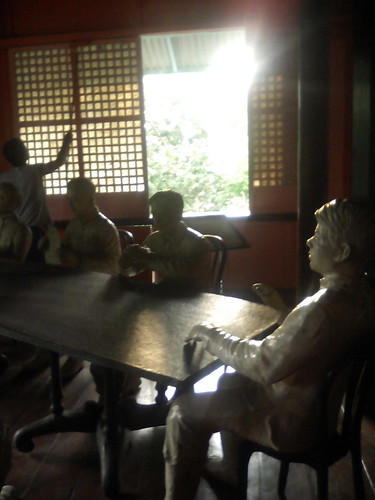
The museum contains a new narrative and interactive displays on the trial of Andres Bonifacio, the events that led to it, and the impact of his execution from the lens of his wife, the Lakambini of the Katipunan, Gregoria de Jesus. The museum also has an e-learning facility where students can access the NHCP’s online lessons on Bonifacio and other Philippine heroes.


 the Lakambini of the Katipunan, Gregoria de Jesus


 new narrative and interactive displays on the trial of Andres Bonifacio

 new narrative and interactive displays on the trial of Andres Bonifacio


 The museum also has an e-learning facility where students can access the NHCP’s online lessons on Bonifacio and other Philippine heroes.


 The museum also has an e-learning facility where students can access the NHCP’s online lessons on Bonifacio and other Philippine heroes.
Me with Hermano Andres Bonifacio Statue


More pictures at Source/Link: 
For news updates please visit the National Historical Commission of the Philippines:
For the re-opening of Bonifacio Trial House and Museum news updates and pictures, you may visit the Facebook of the Municipality of Maragondon:
https://www.facebook.com/photo.php?fbid=679614272151717&set=pcb.679614892151655&type=1&theater


For more information you may contact:

Mr. Melanio Guevara
Shrine Curator of Bonifacio Trial House (0919-580-6365)
Opens on Tuesday to Sunday at 8:00 am to 4:00 pm
For directions and to read my previous blog about Bonifacio Trial House: